
Building a Modern IBM i Screen with Agentic Display Files
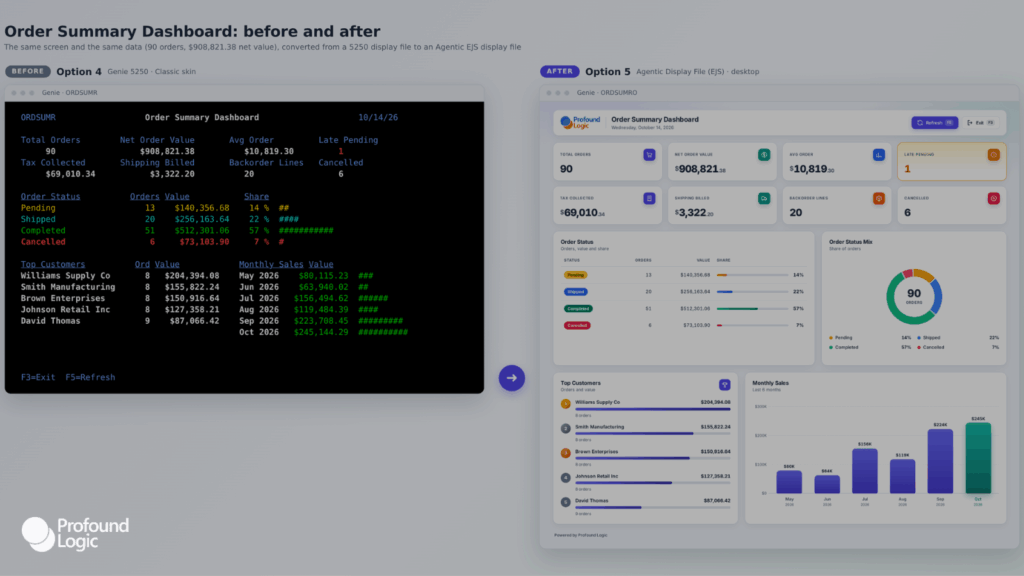
Agentic Display Files remove the widget ceiling on IBM i screen development, but the announcement left the mechanics abstract. Here is what actually happens when a developer builds a real screen with it, from turning the feature on to reviewing a finished, responsive interface the RPG underneath never had to know about.
The Rewrite That Never Shipped. What Failed RPG Replacement Projects Have in Common

Most failed IBM i replacement projects do not fail loudly. They drift for 18 months, then quietly end with the business back on the system it tried to leave. The patterns behind that outcome are predictable, and so is the alternative.
Behind the Brand. The Companies Still Running (and Thriving) on IBM i

For years, running on IBM i got treated like something to explain away. Ryder cut delivery cycle times and saved $30,000 a year on it. Trimble modernized three product lines without losing a customer. Across a dozen more companies, the pattern holds. Here’s the proof, and what comes after it.
You Just Inherited an IBM i Environment. Here’s Where to Start.

Most CIOs and IT directors step into a role they didn’t build the foundation for. On IBM i, that foundation is often decades of undocumented RPG and COBOL. Here’s why that gap is more common than it feels, what it actually costs a new leader, and how to close it before your first real decision.
Stop Guessing Which AI Model to Use: How CoderFlow’s Automatic Model Selection Works

Not every coding task needs your most expensive model, but figuring out which ones do has been a manual guessing game. CoderFlow’s new Auto model selection rates each task and routes it to the right tier automatically, across both Claude and Codex agents.
Inside the Judge: How CoderFlow’s Judge Agents Decide What Ships

Verified, ready-to-commit is the standard. Judge agents are the mechanism. Here’s how CoderFlow actually decides which of several competing implementations ships, what it evaluates to get there, and why a visible decision beats a fast one.
Your Best RPG Developer Retires Next Year. Does Anyone Know What Their Code Actually Does?

Most IBM i organizations don’t have a documentation problem so much as an undocumented-decisions problem. When the developer who wrote a program leaves, whatever they knew about it leaves too. Here’s why that gap is more urgent than most IT leaders realize, and what it actually takes to close it.
One Platform, Any Agent: How CoderFlow Keeps IBM i Teams Out of AI Vendor Lock-In

Autonomous coding agents that work in parallel, run against your repositories, and hand back reviewable code, all under your team’s existing controls. Parallel Agents Reviewable Diffs Governed Access Your Repositories Platform Overview CoderFlow runs AI coding agents inside isolated containers, against your own repositories, and returns their work as changes you review and approve. Submit […]
From One Screen to a Thousand: Futurizing an Entire Application Portfolio

Most futurization conversations start, and often stay, at the scale of a single application. But the real test isn’t whether Futurization works on one flagship program. It’s whether it holds up across an entire portfolio of hundreds, or thousands, of interconnected RPG programs built up over decades.
Why the Right AI Model for Your RPG Codebase Isn’t Always the Same One

Most AI coding tools ask you to trust one model with everything. For decades of RPG and COBOL logic, that trade-off deserves more scrutiny than it usually gets.
Why Most IBM i Shops Haven’t Started With AI Yet (And What the First Step Actually Looks Like)

IBM i leaders are more worried about falling behind on AI than ever before, but worry has not translated into action. Here is what is actually causing the freeze, and a first step that does not require betting the farm.
Your Toughest Futurization Problem Is the People, Not the Platform

A futurization effort can clear every technical hurdle and still stall, because the people who run the business on the same screens every day are afraid of what’s coming. The platform problem is largely solved. The adoption problem is the one your vendor can’t solve for you. Here’s how Agentic Futurization is structured to lower that fear, and the leadership playbook for bringing your team along.
CoderFlow on IBM i: What Real Development Tasks Actually Look Like

Descriptions of agentic coding are easy to find. What is harder to find is a straight answer to a simple question: what does it actually look like when you hand a task to an agent in a real IBM i environment? This post walks through three examples.
AI Digital Labor on IBM i: Scaling Delivery Without Scaling Headcount

The question IT leaders are asking is no longer whether AI can write code. It’s whether AI can take on the sustained delivery work that enterprise teams need done without expanding payroll. On IBM i, the answer is already being demonstrated in production.
IT Builds It. IT Controls It. The Case for Agent-Driven Business Automation on IBM i.

Every IBM i shop has business processes that run on human effort today: repetitive, documented workflows that someone executes manually because no one has gotten around to automating them. CoderFlow gives IT the ability to set up AI agents that handle those workflows autonomously, with full governance and control staying exactly where it belongs.